
Temporal Knowledge Graphs for AI Agents with Graphiti
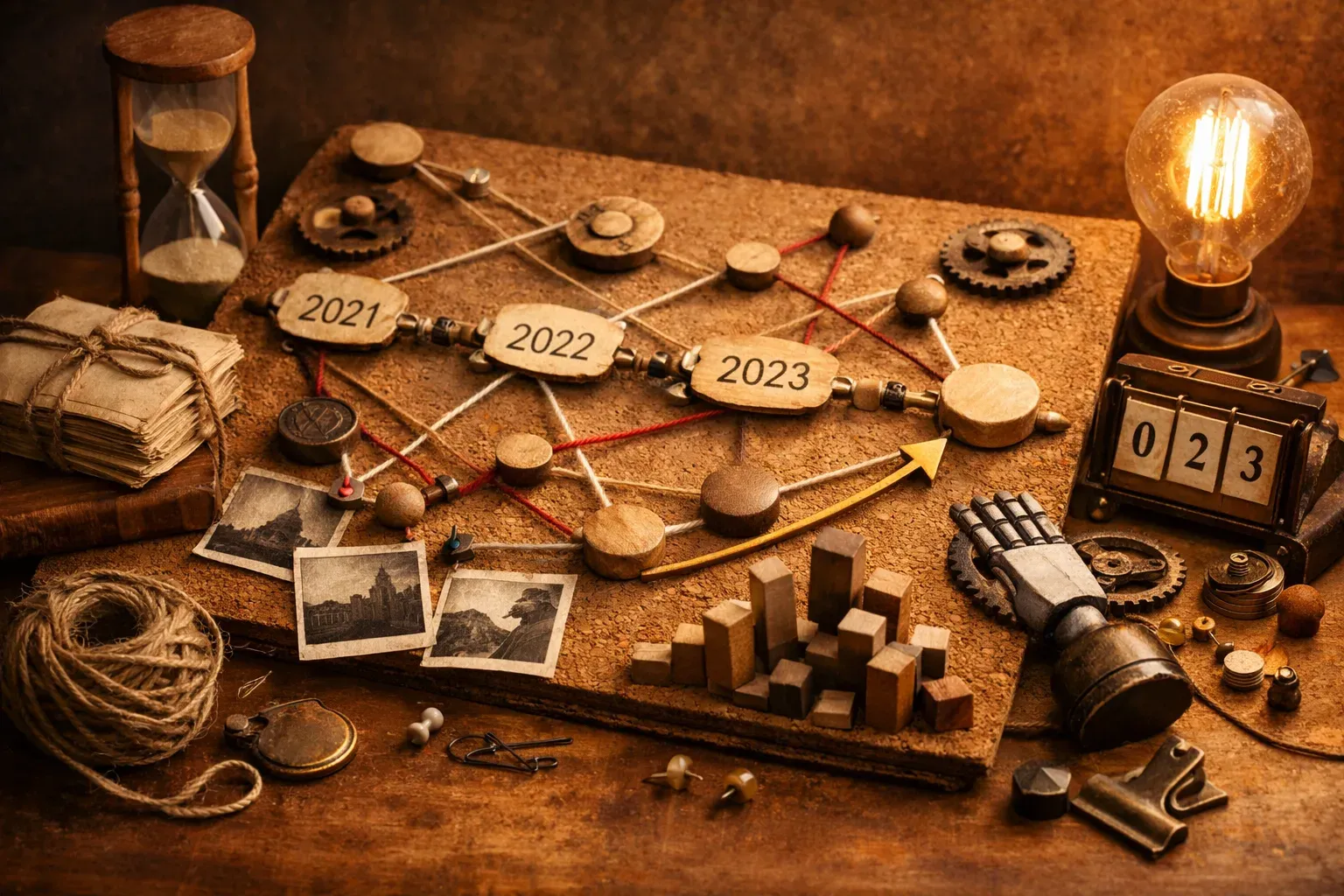
AI agents need more than a pile of retrieved facts. They need facts that know when they were true, when they were learned, and what they replaced. That is the job of a temporal knowledge graph.
A temporal knowledge graph is a knowledge graph where each fact carries time. In practice, that means the system can tell the difference between "the customer uses Slack now" and "the customer used Slack last quarter." It can also keep track of when the system learned a fact, which matters when you are deciding whether to trust it, refresh it, or retire it. As described in Rene Zander's guide to temporal knowledge graphs for AI agents, when a new fact contradicts an old one, the old fact is closed rather than deleted.
That difference matters for AI workflows. Agents do not just retrieve static reference material. They act across sessions, across tools, and across changing work. If your memory layer cannot preserve history, the model will mix current state with stale state and make confident mistakes.
What a temporal knowledge graph is
A temporal knowledge graph is a structured memory layer for relationships that change over time. Instead of storing "Company X uses Product Y" as a single flat record, it stores the fact with dates, source context, and lifecycle state.
That gives you three useful abilities:
- You can answer "what was true then?" as well as "what is true now?"
- You can see which source introduced a fact.
- You can close outdated facts instead of overwriting history.
For AI agents, that is a major upgrade over a plain note store or vector search layer. A flat memory system can surface relevant text, but it cannot reliably tell whether a fact is still valid. Temporal structure gives retrieval some discipline.
Why agents need time-aware memory
AI agents operate in changing environments. A project decision from last week may be obsolete today. A support answer may have been correct before a policy change. A Git decision may have been reversed in a later pull request. If the memory layer does not track time, the agent has no way to distinguish durable context from expired context.
That creates familiar failure modes:
- old decisions keep resurfacing after they were replaced
- the model cites a fact without knowing it is historical
- contradictory records compete with no clear precedence
- users have to manually restate context every time they switch tools
Streamient is built for this kind of workflow. It gives teams a shared, inspectable memory layer for notes, URLs, emails, Git work, and decisions, so AI tools can pull the right context across sessions. For teams that need persistent context across Claude, Cursor, ChatGPT, Windsurf, Zed, and other MCP-compatible clients, the point is not just retrieval. It is continuity. See the feature overview for the current capture and retrieval surfaces, and the compare page if you want a quick sense of when Streamient fits better than a tool that only stores fragments.

How Graphiti-style temporal graphs help
Graph-based memory becomes more useful when it records change, not just connection. That is the core reason temporal graph systems are showing up in agent architectures.
A Graphiti-style workflow usually does four things well:
- Stores entities and relationships: People, projects, systems, preferences, and decisions are linked rather than isolated.
- Attaches time to facts: Each record can reflect when it was observed or valid.
- Closes superseded facts: A newer contradiction does not erase the older record, it ends its validity.
- Supports retrieval with context: The agent can ask for current facts, historical facts, or both.
This is useful when the same relationship changes over time. For example, a project may move from "owned by Team A" to "owned by Team B." A temporal graph can preserve both states, along with the change boundary, instead of leaving you with one overwritten fact and no trail.
That history is also important for trust. If an agent is going to explain why it answered a question a certain way, it helps to have source records that show the sequence of changes, not just the final state.
Where Streamient fits
Streamient is not a graph database product masquerading as memory. It is a shared AI memory layer for teams, with MCP support, source links, editable records, and cross-tool continuity. In practice, that means you can store the work objects that matter to agents and people at the same time: notes, memories, URLs, emails, Git context, and other durable records.
For a temporal workflow, that matters because your memory layer needs more than recall. It needs governance:
- who can write the fact
- which source introduced it
- whether the fact is current or historical
- whether the fact should be superseded or retained
- where the same context should appear across tools
Streamient's features page lists the current MCP tools and storage primitives, including knowledge retrieval, notes, URLs, emails, and Git-connected context. If your agent workflow spans more than one app, that shared layer is the difference between "the model remembers something" and "the team has a system for memory."
If you want the open-source and self-hosting side of that story, the open source page explains how teams can run Streamient themselves.
What changes in the retrieval flow
Temporal memory changes retrieval in two ways.
First, retrieval can rank facts by validity window. If the agent is answering a current-state question, it should prefer the latest open fact. If it is reconstructing a past event, it should retrieve the closed facts too.
Second, retrieval can attach provenance. A good answer should not just say "this is true." It should point to the note, email, URL, or Git record that established it.
That is especially useful in team settings. A support agent, coding assistant, and research workflow may all need the same underlying context, but not the same slice of it. A temporal graph lets each tool ask for the part it needs without flattening everything into one long prompt.
Common mistakes to avoid
A temporal knowledge graph is helpful only if you use it for the right problem.
Do not use it as a dumping ground for every piece of text. A graph full of low-signal entries becomes harder to trust, not easier.
Do not delete old facts when they are superseded. Close them. If you erase the record, you lose the explanation for how the system got here.
Do not retrieve everything by default. Temporal memory should reduce noise, not add more of it.
Do not treat graph structure as a substitute for source quality. If the input is weak, the graph will preserve weak context more neatly.
Streamient's broader memory guidance on what AI memory is and context engineering for AI teams is relevant here: memory works best when it is scoped, source-backed, and tied to actual work objects.
A practical pattern for teams
If you are building an agent workflow around temporal knowledge, start with a small set of facts that actually change.
- store project decisions with dates and owners
- keep source links for each decision
- mark superseded facts as closed, not deleted
- retrieve current facts by default
- include historical facts only when the task calls for them
- review records regularly for stale context and conflicts
That pattern is especially useful when you connect agent memory to emails, Git, or shared team notes. A decision in a thread should not disappear when the next agent session starts. It should become part of the durable record that future tools can inspect.
For teams that want to see this in a broader workflow, Streamient's pricing page shows the current project and access limits, and the blog includes more examples of how AI memory changes coding, support, and context management work.
The bottom line
Temporal knowledge graphs solve a real agent problem: context changes, but most memory systems do not understand change. By attaching time to facts and closing outdated records instead of deleting them, you give AI agents a better way to reason about what is current, what is historical, and what should no longer drive decisions.
Graphiti-style temporal memory is useful when your agents need continuity across sessions and tools. Streamient is useful when that continuity needs to be shared, editable, inspectable, and governed by a team instead of trapped in one chat.
If you are building AI memory for real work, that combination is the point.